
How to Start a Faceless ASMR Channel With AI (and What It Actually Pays)
AI ASMR is the easiest faceless YouTube niche to enter in 2026: what Shorts pay per million views, YouTube's AI monetization rules, and the exact prompts.
The short version
A faceless ASMR channel posts oddly-satisfying trigger videos (glass fruit cutting, honey dipping, soap slicing) without the creator ever appearing on camera. In 2026 the entire production side can be AI: you write a prompt, a video model renders the clip and the sound, and YouTube pays out once you cross 1,000 subscribers plus 10 million Shorts views in 90 days. The videos are cheap to make. The part that decides whether you grow is the prompt, and the free AI ASMR generator writes it for you.
A faceless ASMR channel is a volume game with almost zero production cost, which is exactly why AI took it over first.
What is a faceless ASMR channel?
A faceless ASMR channel is a YouTube or TikTok channel built entirely on sensory trigger videos, cutting, tapping, squishing, pouring, with no on-camera host, no voice, and no personal brand. ASMR consistently ranks among YouTube's most-searched terms, and the faceless format means one person can run several channels at once, which is why “faceless” niches dominate every list of faceless YouTube channel ideas for beginners.
Classic ASMR still needed gear: a good binaural microphone, props, lighting, editing. The AI version needs none of it. Modern video models with native audio generate the visual and the sound in one pass, so the whole channel reduces to a pipeline of prompts. In AI ASMR, the sound is the product and the picture is the packaging.
Why is AI ASMR the niche taking over short-form video?
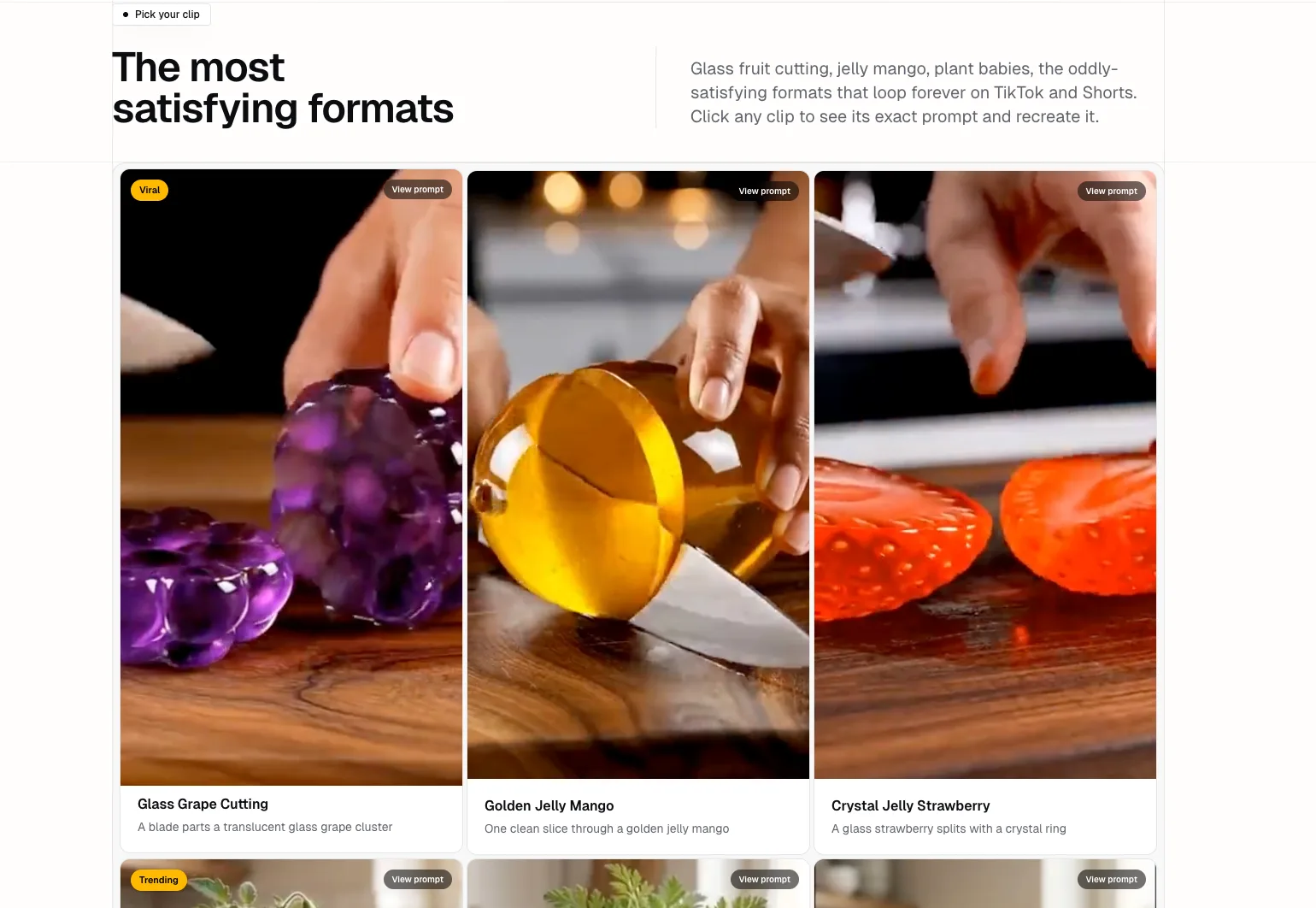
AI ASMR exploded because it sits at the intersection of three things the Shorts algorithm rewards: high completion rate (clips run 5 to 10 seconds), infinite novelty (a glass strawberry cannot exist, so nobody has seen one), and replayability (viewers loop satisfying cuts). The signature trend is glass fruit cutting: hyper-real fruit rendered as translucent glass or jelly, sliced in one clean stroke with a crisp chime.
These clips are impossible to film and easy to generate, which inverts the usual economics of viral content. Here is one of ours, straight from the generator's template library:
Can you actually make money with a faceless ASMR channel?
Yes, through four stacked routes: Shorts ad revenue, long-form ad revenue, fan funding, and brand or affiliate deals. Shorts ads unlock at 1,000 subscribers plus 10 million valid Shorts views in 90 days (or 4,000 public watch hours in 12 months for long-form), and fan funding unlocks earlier, at 500 subscribers and 3 million Shorts views.
| Revenue route | Unlocks at | What it pays |
|---|---|---|
| Shorts ads | 1,000 subs + 10M Shorts views / 90 days | ~$0.01-$0.10 RPM; roughly $30-$100 per 1M views |
| Long-form ads | 1,000 subs + 4,000 watch hours / 12 months | 10-100x more per view than Shorts |
| Fan funding (Super Thanks, memberships) | 500 subs + 3M Shorts views or 3,000 watch hours | Direct viewer payments, no ad middleman |
| Brand & affiliate deals | No threshold, audience-dependent | Negotiated; the answer to earning without ads |
The numbers that matter: Shorts RPM typically runs $0.01 to $0.07 per 1,000 views, with strong niches and US-heavy audiences reaching around $0.10. Shorts ads pay roughly $30 to $100 per million views, so a faceless ASMR channel is a volume game, not a jackpot. The same vidIQ analysis notes long-form earns 10 to 100 times more per view, which is why the standard playbook is: go viral on Shorts, then funnel subscribers into 30-60 minute ASMR compilations where the real RPM lives.
Play with the math yourself:
Shorts ad-revenue estimator
Drag to your monthly Shorts views. Estimates use the published Shorts RPM range of $0.01 to $0.10 per 1,000 views; your real rate depends on audience geography and season.
- Estimated ad revenue / month
- $5.01 to $50.12
- Shorts monetization threshold (10M views / 90 days)
- 1.5M of 10M every 90 days (15%)
Will YouTube demonetize AI-generated ASMR?
No, not for being AI. On July 15, 2025 YouTube renamed its repetitious-content rule to the “inauthentic content” policy, and explicitly clarified that AI-assisted content stays monetizable as long as it is original and not mass-produced template spam. YouTube does not demonetize AI content; it demonetizes repetitive content.
Enforcement is real: in early 2026 YouTube reportedly removed a batch of 16 AI-driven channels that had accumulated billions of views between them. The channels that got hit were the ones uploading near-identical videos at scale. The survivors, and there are plenty, treat every upload as a distinct idea. Practically, that means three rules for an AI ASMR channel:
- Vary the concept, not just the fruit. Glass grape today, lava-core kiwi tomorrow, frozen honey the day after. New material, new sound, new physics.
- Make the audio carry information. A generic whoosh reads as slop; a material-specific cue (the chime of glass, the crackle of freeze-dried candy) reads as craft.
- Disclose synthetic media where required. YouTube's upload flow asks whether content is realistic AI; ticking the box costs nothing and protects the channel.
How do you make ASMR videos with no camera and no mic?
You describe the clip precisely enough that an AI video model can render it, audio included. A working AI ASMR prompt runs 150 to 250 words and pins down five things: the material, the action, the camera, the lighting, and a negative list of everything the model must not do. We learned that by generating the demo clips for the free AI ASMR generator, six published clips and a lot of failed takes.
The failures taught us more than the successes. Short prompts (“satisfying glass fruit cutting ASMR”) produced wobbling jelly, melting edges, and physics that break the trance the whole genre depends on. The sound failed the same way: without an explicit audio cue, models default to generic music instead of the crisp material sound that makes ASMR work. What fixed both was specificity. Here is the exact prompt behind the grape clip above, verbatim from the tool:
{
  "fruit": "Translucent Grape Cluster",
  "aspect_ratio": "9:16",
  "duration_seconds": 8,
  "prompt": "Extreme macro cinematic food videography. A perfectly formed cluster of deep purple grapes sits centered on a premium dark walnut cutting board. Every grape maintains realistic natural proportions, subtle surface bloom, tiny stem connections and slight organic imperfections, while the entire cluster is made from highly transparent glass-like gelatin with exceptional internal clarity. Small suspended air bubbles and delicate internal light refractions are visible throughout the material.\n\nA razor-sharp polished Japanese chef's knife slowly enters from above. The blade aligns perfectly with the center of the grape cluster before applying smooth, uninterrupted downward pressure. The knife slices effortlessly through every grape in a single continuous motion with no hesitation, compression or tearing. The gelatin behaves like firm crystal jelly, producing an extremely clean cut with glossy exposed cross sections that sparkle under the lighting.\n\nAs the blade exits the cutting board, both halves naturally separate by a few millimeters under their own weight while maintaining structural integrity. The freshly cut surfaces shimmer with realistic reflections, transparency and internal refractions. Tiny highlights travel across the cut faces as the camera remains perfectly locked.\n\nProfessional cinema lighting with a large soft key light from camera left, subtle warm rim light, rich shadows, dark blurred luxury kitchen background, extremely shallow depth of field, 100mm macro lens, f/2.8, HDR, ultra photorealistic, premium food commercial quality, satisfying ASMR aesthetic.\n\nNo deformation, no melting, no wobbling, no liquid leakage, no camera shake, no unrealistic physics, no extra objects, no text, no hands visible, no stylization, only realistic materials and motion."
}
Notice the last paragraph: no deformation, no melting, no wobbling, no camera shake, no hands. That negative list is the difference between a clip that loops cleanly and a clip that reads as AI slop. The prompt is the only part of a faceless AI channel you cannot automate away, so it is the part worth getting right.
How do you start a faceless ASMR channel this week?
The whole loop takes about an hour a day: generate a prompt, render the clip, post it vertical, repeat. Five steps:
- 1Pick one trigger familyGlass fruit, honey dipping, lava slicing, frozen textures. One family gives the channel an identity; you rotate materials inside it for variety.
- 2Generate the promptThe free AI ASMR generator writes the full structured prompt (material, action, camera, lighting, audio cue, negative list) in about 30 seconds, no signup.
- 3Render it in any AI model you likePaste the prompt into an AI video studio and generate at 9:16, 5-10 seconds. Pick a model with native audio so the sound comes out of the same pass.
- 4Post daily, one clip per ideaUpload as a Short with a trigger-specific title. Daily variation is both the growth strategy and the thing that keeps you on the right side of the inauthentic-content policy.
- 5Stack the revenue as you cross thresholdsFan funding at 500 subs + 3M views, Shorts ads at 1,000 subs + 10M views, then long-form compilations where RPM is 10-100x higher.
Bottom line
Faceless ASMR is the lowest-barrier way into AI video that actually pays: no camera, no mic, no face, thresholds you can see from day one, and a format the Shorts algorithm structurally favors. The economics are honest rather than glamorous ($30 to $100 per million Shorts views, real money arriving with long-form), and the moat is not equipment, it is prompt quality and daily variation. Both of those are exactly what the free AI ASMR generator is for. Generate your first glass-fruit prompt and post it tonight.
Frequently asked questions
Do faceless ASMR channels make money?
Yes, through four stacked routes: Shorts ad revenue, long-form ad revenue, fan funding, and brand or affiliate deals. Shorts ads pay roughly $30 to $100 per million views, so the format is a volume game; the bigger money arrives when a channel funnels Shorts viewers into 30-60 minute long-form compilations, where revenue per view is 10 to 100 times higher.
How much do ASMR YouTubers make per 1,000 views?
On Shorts, typically $0.01 to $0.07 per 1,000 views, with strong niches and US-heavy audiences reaching around $0.10. On long-form video the rate is 10 to 100 times higher, which is why established ASMR channels publish long compilations and use Shorts mainly as a discovery funnel. Audience geography is the biggest single variable.
How do ASMR YouTubers make money without ads?
Fan funding (Super Thanks, channel memberships) unlocks at just 500 subscribers plus 3 million Shorts views, long before ad revenue. On top of that, ASMR channels earn through affiliate links, brand placements inside clips, and licensing clips to compilation pages. None of those require YouTube Partner Program ad approval.
Can you monetize AI-generated ASMR videos on YouTube?
Yes. YouTube's July 2025 'inauthentic content' policy update explicitly keeps AI-assisted content monetizable as long as it is original rather than mass-produced template spam. What gets demonetized is uploading near-identical videos at scale. Vary the concept per upload, keep the audio specific to the material, and disclose realistic synthetic media in the upload flow.
How do I start a faceless ASMR channel with no camera?
Pick one trigger family (glass fruit is the proven one), generate a structured prompt with the free AI ASMR generator, render the clip in any AI video model with native audio, and post it as a 9:16 Short. The prompt step takes about 30 seconds and needs no signup; most AI video studios have a free tier, so the first clips can cost nothing.
What AI ASMR videos go viral right now?
Impossible-material triggers dominate: glass or jelly fruit being sliced in one clean stroke, honey-coated objects being dipped and lifted, glowing lava-core food being cut, and frozen textures cracking. They work because they loop cleanly, run 5-10 seconds, and show something that cannot be filmed in reality, which makes the clip inherently novel.
Keep reading
Dolly Zoom: How the Vertigo Effect Works (and How I Faked It With AI)
Hitchcock needed a dolly track and a rehearsed crew. I needed a prompt. An interactive breakdown of how the vertigo effect works, plus the experiment that got AI models to stop faking it with a plain zoom.
Read moreImage to Video AI: How to Turn Any Photo Into a Video (Free)
A beginner's guide to free image-to-video AI: start from a real photo (especially for faces), the motion-prompt formula, and why SeeDance 2.0 beats Kling, Veo, Grok, and Midjourney.
Read moreHow to Make a Talking Dog Video for Free (the 'I'mma Bite You' Meme)
The behind-the-scenes method: I had Gemini watch the viral clip and write the prompt that recreates it, with no motion software and no $40/month tool. How to replicate it free with your own dog.
Read more