
Who Is Jean Phil? The AI Influencer Blueprint Everyone Is Copying
Jean Phil went from one post to tens of millions of views in three weeks. The documented timeline, the real-or-AI evidence, the meme coin numbers, and the template behind it.
The short version
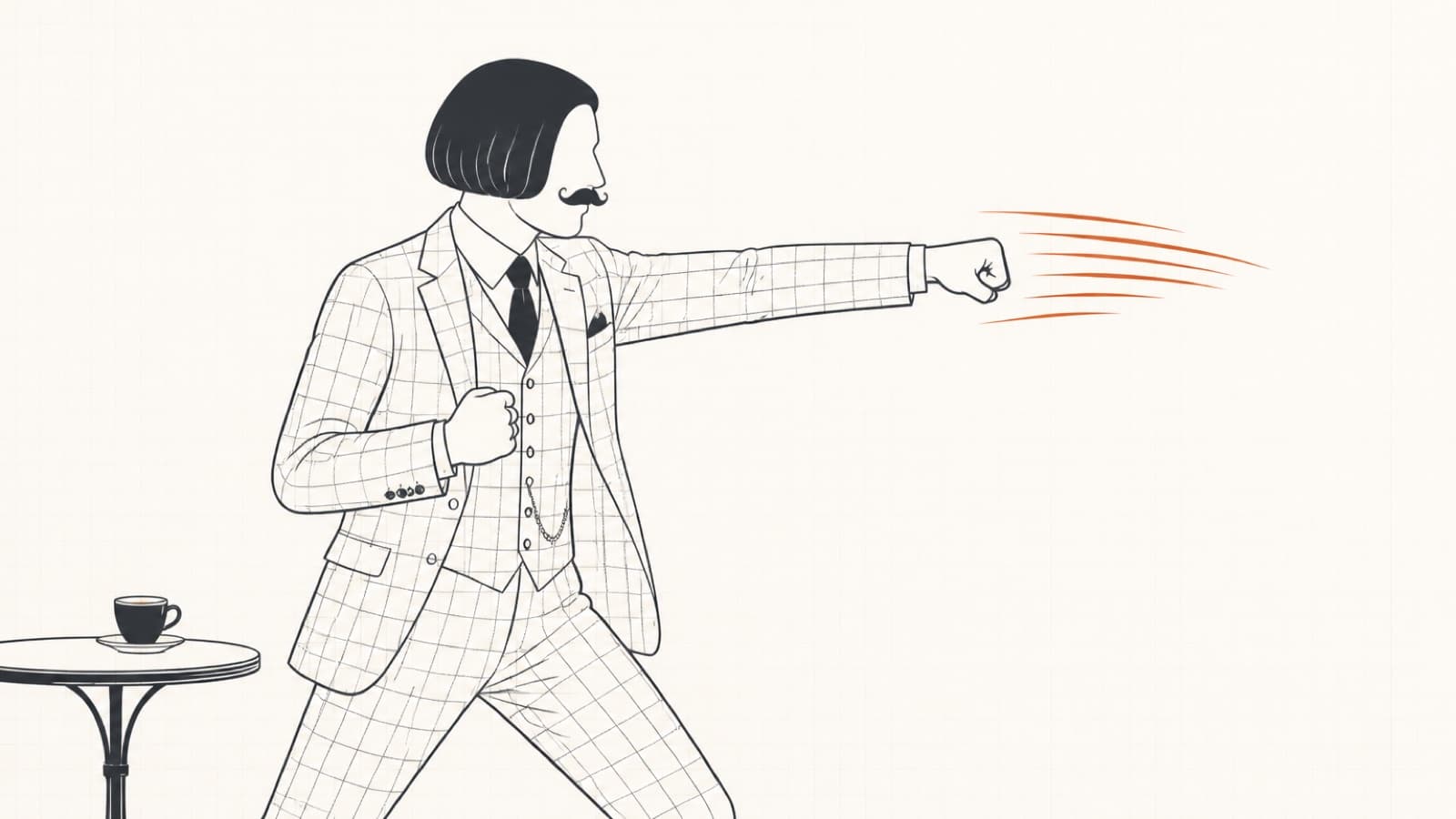
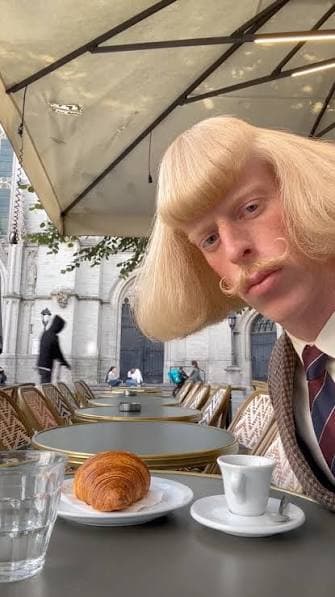
Jean Phil (full handle Jean Philanthrope) is an internet character who appeared on Instagram and TikTok around September 17, 2026, wearing a brown houndstooth suit, a blonde bob and a curled mustache, and who shadow boxes silently in cafes, parks and streets. He has never spoken on camera, never given an interview, and no verified identity sits behind the account. Within three weeks he had tens of millions of views, a Solana meme coin, a fake British rival and hundreds of copycat characters.
Most outlets covering him now describe him as AI generated. The more useful fact sits underneath that argument. Jean Phil was never really one man. He was a template, and the template is what everybody copied. If you want to run that template yourself, the part that actually decides whether it works is the character reference, which is what the free AI character sheet generator exists to build.
The timeline, as far as it is documented
Jean Phil went from a first known post on September 17, 2026 to a global meme in roughly three weeks. The outlets covering him disagree about almost every detail of that run, including what his first video even showed, because nearly all of them worked from the same handful of viral clips rather than from any backstory.
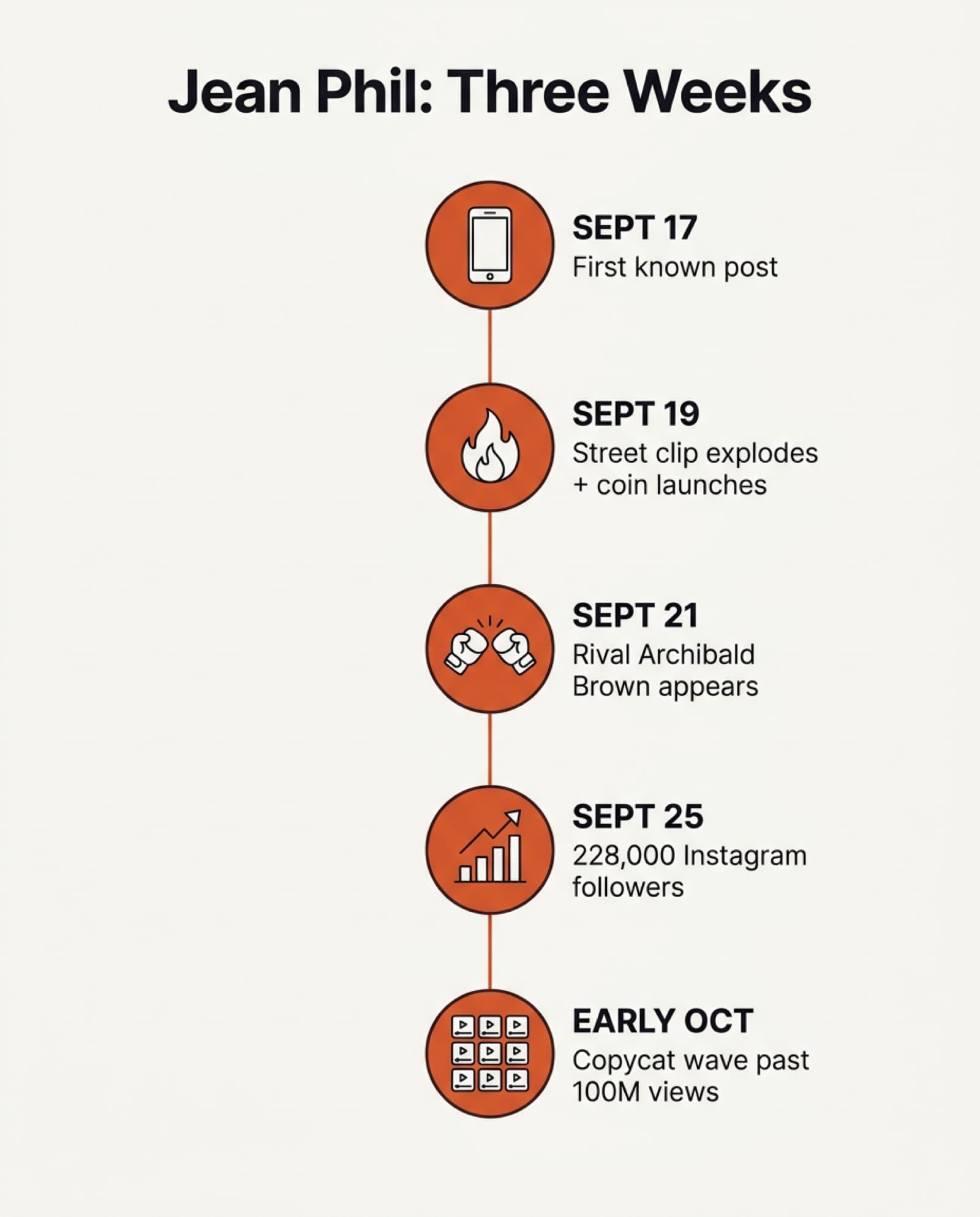
- September 17, 2026. The earliest known post, according to Dexerto. What it showed depends on who you read: Pointe Tribune described an apartment, The Tab described him boxing in a kitchen and put the clip at 13.8 million views, and the French tech site Rotek described a street video set to a French rap track and credited it with 35 million views.
- September 19, 2026. The explosion. A street shadow-boxing clip crosses a million views in hours and keeps going. The same day, a Solana token carrying his name appears on pump.fun, its description echoing his caption catchphrase, “Oui, madame.”
- September 19 to 21.Archibald Brown shows up: a British character with his own dramatic haircut who presents himself as Jean Phil’s rival and keeps challenging him to a fight. LADbible covered the rivalry as a second act of the same story. He gets a coin too.
- September 25, 2026. Dexerto counts more than 228,000 Instagram followers. The Tab counts roughly 190,000 TikTok followers from just seven videos, each between 1.7 and 9.8 million views. LADbible and EarlyGame report a single clip at 35.9 million.
- Early October 2026. Jean Phil style clips, remixes and dance edits are their own genre, with the imitation wave reported past 100 million TikTok views and some of those accounts sitting under 3,000 followers.
Three weeks. No face reveal, no voice, no backstory, no interview.
Why did Jean Phil go viral?
Because the format is close to perfect, and the format is the product. Every clip runs the same shape: a tight stare into the camera, a step back into somewhere ordinary, then wordless shadow boxing, then back to his face. Nothing about that structure depends on how the video was made.

- 1. It reads in one second. The hair, the mustache, the suit. You know who this is before you know what you are watching.
- 2. It has no language barrier. He never speaks, so the joke needs no translation. The nicknames commenters gave him, French Lord Farquaad and Poodle Man, traveled instantly.
- 3. It is infinitely repeatable. The location changes, nothing else does. Every upload is the same joke in a new room, which is exactly what short-form algorithms reward.
- 4. It invites a reply. A silent man punching the air in a cafe is a setup, not a punchline. Other accounts finished the joke for him.
- 5. It is deadpan. He never reacts to the nicknames, never breaks, never posts a thank-you-for-200k. The silence is the character.
The joke was genuinely good, and that is the part people skip when they explain the whole thing away as a scam.
Is Jean Phil real or AI?
Almost every outlet that covered him, including Dexerto and LADbible, describes Jean Phil as AI generated, and Know Your Meme files him that way while noting there has been no definitive confirmation either way. Nobody has published proof of who made him.
What points to AI. No online history before September 2026: no old photos, no earlier accounts, no interviews, and nobody has put a name to whoever runs the account. Creators have also said publicly that his likeness circulates as an AI overlay, meaning anyone can lay his face and outfit over their own footage.
What points to a real performer underneath. Each clip looks like a single continuous phone shot in a real location with real passers by. Reviewers going frame by frame found no melting hands and no garbled signage. Later clips reference a real French rapper and Paris Fashion Week.
The strongest piece of evidence is not about Jean Phil at all. It is Archibald Brown. Rotek reported that Archibald’s first video matches Jean Phil’s movements down to a tenth of a second, in the same kind of setting, with background traffic passing at the same moment. CoinTribune flagged the same overlap. Real footage of two different men in two different cities does not line up frame for frame. The simplest explanation is one piece of source motion with a different face and outfit laid over the top.
That does not prove nobody performed the original. It proves at least one of those two videos is not a genuine recording of the man it shows. CoinTribune, writing on September 28, was the most careful of the lot: no available source lets anyone determine with certainty who Jean Philanthrope is.
The honest verdict: the man you see in these videos, as he appears, is very likely not a real person. Somebody real is behind him. Nobody has shown who.

What about the Jean Phil coin?
Two days after the first known post, a token carrying his name launched on pump.fun, where anyone can mint a meme coin on Solana, and his Instagram bio pointed at it. Whoever controls the character’s main account was pointing its audience at a token. Every reported valuation since then contradicts the others.
| Reported by | Figure | When |
|---|---|---|
| BullX | ~$3.6M market cap, ~16,000 holders | Sept 21 |
| CoinTribune / Rotek | Peak near $12.2M | Within a week of launch |
| Dexerto | ~$8.8M, then roughly $6M a day later | Sept 25-26 |
| LADbible, citing Coinbase | High around $0.028, then a drop of more than 99% the same day | Sept 21 |
| Dexerto | Main trading pool held about $415,000 | Sept 25 |
Those figures cannot all be describing the same thing, so treat every crypto number in this story as a snapshot rather than a fact. Two things are worth understanding regardless of which one is right. Market cap is the latest price multiplied by every coin in existence, so it is neither cash nor what anyone earned. And with a trading pool around $415,000, a few large sales could move that headline number a long way.
The account posted that it would never announce price targets or promise returns, then that it had sold no tokens and that everything was verifiable on chain. Some users said they checked the creator wallet and found no sales, and coin coverage reported an on-chain check by Cybernews that found no sign of the creator dumping. Others replied with the obvious: this is what every scammer says. BullX noted the project has no white paper, no audit and no disclosed team. Launching a meme coin is not a crime, and no public evidence shows the people behind Jean Phil sold tokens or misled buyers. The timing is still the timing.
The copy wave is the actual story
Jean Phil did not stay alone for a week. Archibald Brown got a coin that reportedly topped a million dollars before falling to around $125,000. Then came Nigel Bat with a black bob, and Derek Mercer, a muscular character whose token sat around $74,000. Hundreds of Jean Phil shaped personas followed: Marlon, Tia Ofil, Phil Jan, whole gangs of them doing the same walk, the same punch, the same stare.
Dexerto summed up the formula better than anyone: create a memorable AI persona, give it a repeatable visual joke, build a fake feud, then attach a coin so traders have a reason to promote every clip. Nobody has shown that the accounts share an operator. CoinTribune found similarities and interactions between them, but not an identity.
Delete the coin step and what is left is not a scam, it is a repeatable production method for characters. That method is the part worth learning.
What is an AI influencer, and is Jean Phil one?
An AI influencer is a social media persona whose face, voice or entire body of content is generated rather than filmed. Some are open about it, like the virtual models brands have used for years. Some are not, which is the category Jean Phil fell into: a persona with no disclosed creator, no stated method and a bio link to a token.
That distinction matters more than the technology does, because the generation method is the same either way. What changes is whether the audience knows. Jean Phil worked because viewers could not tell, and the argument over whether they should have been able to tell is exactly what earned him a hundred million views of free press.
The version of this that behaves like a business is the disclosed one. A character people know is synthetic can still carry a brand, a product line and a daily posting habit, and it does not collapse the day somebody proves what it is.
How to make an AI influencer like Jean Phil
Five steps, in the order that decides the outcome. Only one of them is about generation: the rest is casting and writing. That ratio is why so many of the Jean Phil copies pulled millions of views from accounts with fewer than 3,000 followers, and why so many others never landed at all.
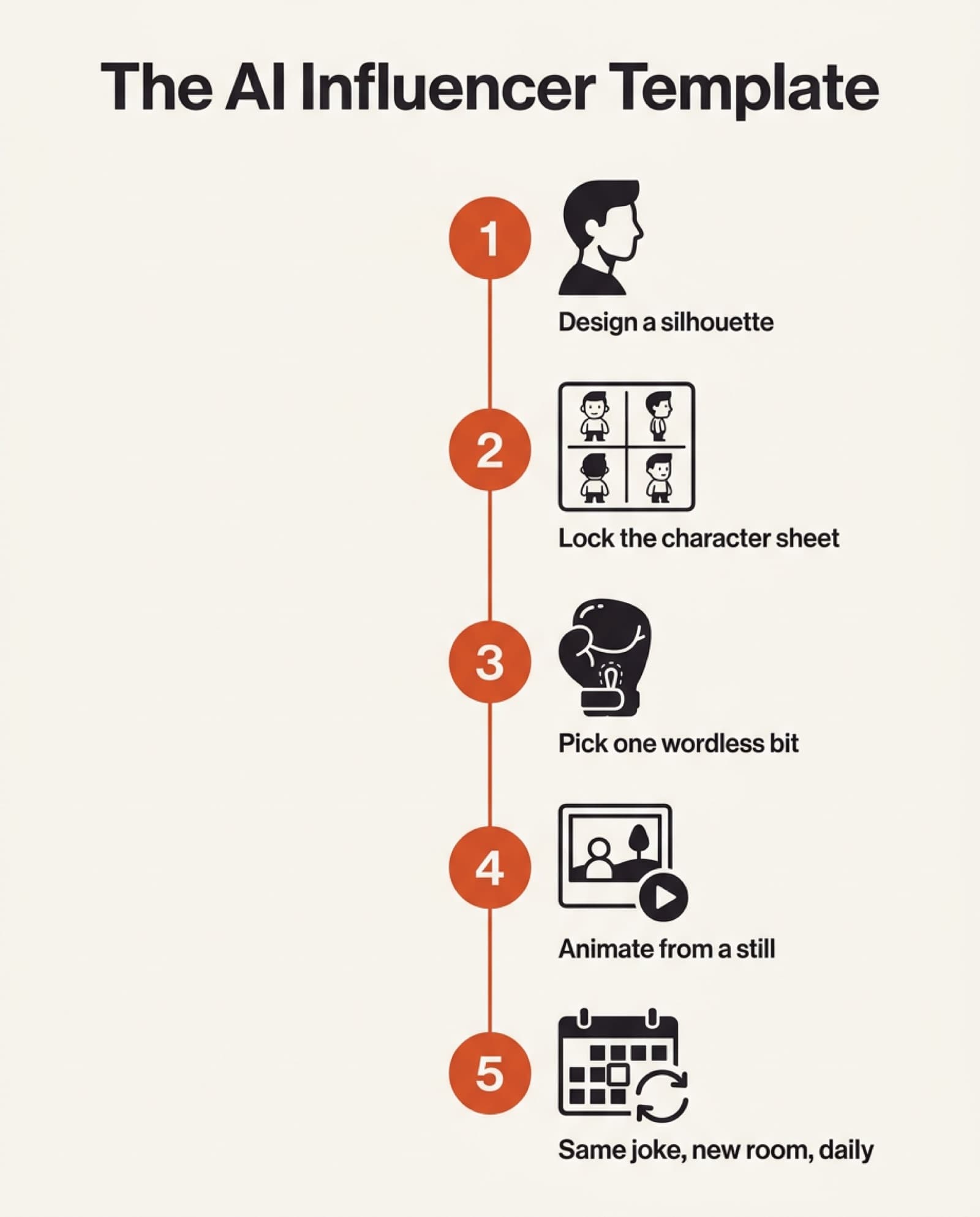
1. Design a silhouette, not a face
Jean Phil is a blonde bob, a curled mustache and a brown tweed suit. You can identify him at thumbnail size with the sound off. Pick three visual features and never change them.
2. Lock the character to a reference sheet
Generate front, profile, three-quarter and full-body views in one wardrobe, approve them, then reference that sheet in every later clip. Skip this and you get a slightly different person every video, which is the single most common failure in the copycat wave.
3. Pick one repeatable bit with no dialogue
Shadow boxing. A stare. A walk. It has to survive being done a hundred times in a hundred locations, and it has to read without language so it travels past your own country.
4. Generate clip by clip from a still, not from scratch
Start from an image you already control and animate it. That is what makes these videos read like phone footage instead of looking generated, and it is why the Archibald Brown clip reused Jean Phil's motion instead of inventing new motion.
5. Post the same joke in a new room, daily
The format is the asset. Jean Phil pulled tens of millions of views across roughly seven videos because every upload was the identical premise with exactly one variable changed.
Step 2 is the whole ballgame, and it is the step the tutorials skip. A character sheet is a structured prompt, not a vibe, and it looks like this:
Character reference sheet, four views in one frame: front, profile, three-quarter, full body.
Subject: man in his 40s, tailored brown houndstooth three-piece suit, pale blue shirt, no tie,
chin-length blonde bob with volume, tightly curled mustache, neutral unsmiling expression.
Consistent face, consistent wardrobe, consistent proportions across all four views.
Neutral studio background, soft even lighting, no props, no text, no logos.
Write that once and reuse it forever. The free AI character sheet generator builds the full version in about 30 seconds, including the turnaround views and the negative list, and hands you a prompt you can paste into any AI model you like. If you want to see the same character-first workflow applied to a longer format, the AI drama series breakdown shows what 17 creators independently converged on, and they all put the character sheet first too.
How to tell when a new character is synthetic
Forget hands and glitches, because the current generation of models stopped producing those reliably. The tells that still hold up are structural: no history, identical motion across accounts, and a bio link to something you can buy. Our AI video detection statistics page tracks how poorly both people and tools do at this now.
- 1. Does this person exist anywhere before the videos? No old photos, no earlier accounts, no interviews is a signal, though plenty of real people have no public past online. Absence of evidence is not proof.
- 2. Do the clips match other accounts too closely? Identical movement and identical background timing across two different people is the tell that actually holds up, and it is what exposed the Jean Phil and Archibald Brown pair.
- 3. Is there a link in the bio asking you to buy something? Especially a token that launched days after the first post, with no white paper, no audit and no named team.
None of those three proves a scam on its own. Together they tell you when to slow down before you spend a cent.
The bottom line
The lesson of Jean Phil is not that AI influencers are coming. It is that a character with no past, no voice and no backstory out-performed almost every real creator on the platform for three straight weeks, because the format was better than theirs. One viewer summed the whole episode up better than any of the coverage did: “I never get tricked by AI. I was tricked by AI.”
You do not need to fake a person to use any of this. Build a character you are open about, give it one repeatable bit, keep the look identical, and post the same joke in a new room until people start finishing it for you. Skip the coin. The next character that takes over your feed will probably be made by one person with a reference image and a good idea.
Frequently asked questions
Who is Jean Phil?
Jean Phil, full handle Jean Philanthrope, is an internet character who went viral in September 2026 shadow boxing silently in a brown houndstooth suit with a blonde bob and a curled mustache. He has never spoken on camera or given an interview, and no verified identity has been published for whoever runs the account.
Is Jean Phil AI generated?
Almost every outlet covering him, including Dexerto and LADbible, describes him as AI generated, and Know Your Meme files him that way while noting there has been no definitive confirmation. The strongest evidence is that his supposed rival Archibald Brown's first video reportedly matches his movements and background traffic frame for frame, which real footage of two different men would not do.
Why is Jean Phil called Poodle Man?
Commenters nicknamed him Poodle Man and French Lord Farquaad because of the fluffy chin-length blonde bob. He has never reacted to either nickname, which is part of why they stuck.
What is the Jean Phil catchphrase?
“Oui, madame.” It appears in his captions, in the name of the X account that posts in his name, and in the description of the Solana token that launched two days after his first known post.
Is there a Jean Phil coin?
A Solana token carrying his name launched on pump.fun around September 19, 2026, two days after his first known post, and his Instagram bio pointed at it. Reported valuations conflict badly, from about $3.6 million to a peak near $12.2 million, with one outlet reporting a drop of more than 99 percent in a single day. The project has no white paper, audit or disclosed team.
Can I create an AI influencer myself?
Yes. The working method is a locked character reference sheet plus image-to-video generation, one repeatable action with no dialogue, and a daily posting cadence. The hard part is the character design and keeping it consistent, not the generation itself.
Is it legal to create an AI influencer?
Creating a fictional synthetic persona is legal in most places. What creates liability is using a real person's likeness without permission, failing to disclose paid promotion, or attaching a financial product to the character. Disclosure rules for AI-generated content are tightening on both Meta and TikTok, so label it.
How do you keep an AI character consistent across videos?
Build a character sheet once, with front, profile, three-quarter and full-body views in a single wardrobe, and reference that sheet in every generation instead of rewriting a description each time. Prompt-only consistency drifts within a few clips, which is the most visible flaw in the Jean Phil copycat wave.
Keep reading
How to Make an AI Drama Series (What 17 Creators Actually Agree On)
Vertical, serialized, made entirely with AI: AI drama series are a real format with real production failures. What 17 tutorials actually agree on, where they disagree, and which market-size numbers hold up.
Read moreImage to Video AI: How to Turn Any Photo Into a Video (Free)
A beginner's guide to free image-to-video AI: start from a real photo (especially for faces), the motion-prompt formula, and why SeeDance 2.0 beats Kling, Veo, Grok, and Midjourney.
Read more